
Tomonari Nishikawa
This spring, Cornell Cinema will celebrate the life and work of experimental filmmaker Tomonari Nishikawa, who tragically passed away last spring at the untimely age of 55.
Tomonari Nishikawa was inspiring experimental filmmaker, who taught in the Cinema Department at Binghamton University. Born in Nagoya, Japan, Tomonari Nishikawa studied economics and worked in various jobs before immigrating to the United States in 1999 to study film and philosophy at the SUNY at Binghamton, and later pursued an MFA at the San Francisco Art Institute Graduate School. He eventually returned to Binghamton University as a film professor where he continued to both create artworks and pursue other creative endeavors, including co-founding Kuala Lumpur Experimental Film and Video Festival (KLEX) and Transient Visions: Festival of the Moving Image. Nishikawa’s films have screened at film festivals and museums internationally, including the Berlinale, Edinburgh, Hong Kong, London, Singapore, and Toronto International Film Festivals, New York Film Festival, MoMA P.S.1, International Film Festival Rotterdam, and Media City Film Festival.
Nishikawa was widely admired in the world of avant-garde cinema not only for his compelling creative work but also for his commitment to nurturing young filmmakers as a educator, mentor, and curator in Binghamton and beyond. His loss is deeply felt across the entire experimental filmmaking community, including at Cornell Cinema where he was for many years an important creative partner on our "Experimental Lens" programming.
Working mainly in Super 8 and 16mm, Nishikawa was deeply interested in the materiality, process, and apparatus of cinema. His body of work reflects this persistent curiosity about and experimentation with techniques like in-camera editing, optical printing, and much more. Often guided by complex formulas or ideas about process, place, and temporality, his films are at once playful and rigorous, structured and spontaneous, filled with mesmerizing imagery that celebrates the textures, structures, and aesthetic unpredictability of everyday places.
Our Cornell Cinema program will feature six of Nishikawa's incredible films:
sound of a million insects, light of a thousand stars (2014, 2 min, digital, color, stereo)
Nishikawa buried a 100-foot 35mm negative film under fallen leaves alongside a country road, which was about 25 km away from the Fukushima Daiichi Nuclear Power Station, from the sunset of June 24, 2014, to the sunrise of the following day. The night was beautiful with a starry sky, and numerous summer insects were singing loud. The area was once an evacuation zone, but now people live there after the removal of the contaminated soil.
Apollo (2003, 6 min, 16mm, b&w, opt)
This film has four parts, separated by the techniques Nishikawa used: photogram, single-framing, shooting 16mm filmstrips by a 35mm still SLR camera, and reticulation. The sound information of the photogram and the images shot by an SLR spread on the optical soundtrack area, and he scratched the optical soundtrack area for the sound of the single-framing and reticulation parts. He made this film as his senior thesis project at SUNY Binghamton with Julie Murray as his advisor.
Ten Mornings Ten Evenings and One (2016, 10 min, 16mm, color, sound)
It displays bridges on Yahagi River, which runs near where Nishikawa grew up in Japan. He shot each bridge twice, first in the morning and second in the evening of the day. It was exposed one-sixth of the frame at a time and the result would show the sense of the sun rising or setting.
45 7 Broadway (2013, 5 min, 16mm, color, sound)
This is about Times Square, the noises and movements at this most well-known intersection. The film was shot on black and white films through color filters, red, green, and blue, then shots were optically printed onto color films through these filters. The layered images of shots by handheld camera would agitate the scenes, and the advertisements on the digital billboards try to pull ahead of others.
Amusement Ride (2019, 6 min, 16mm, color, sound)
Shot with a telephoto lens from inside a cabin of Cosmo Clock 21, a Ferris wheel at an amusement park in Yokohama, Japan. The distorted image shows the structure of the Ferris wheel, focusing on the intermittent vertical movement, which resembles the movement of a film at the gate of a film projector or camera.
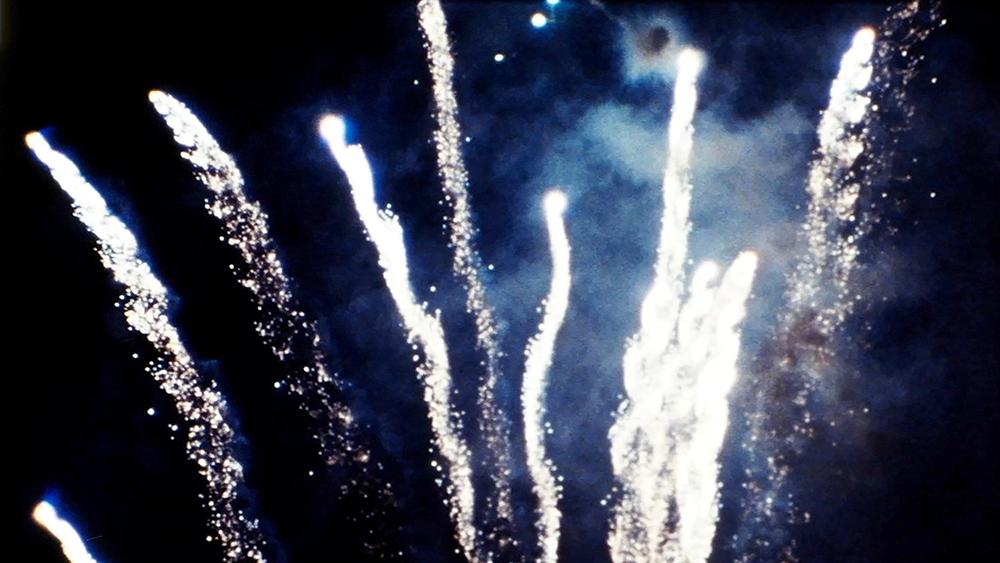
Light, Noise, Smoke, and Light, Noise, Smoke (2023, 6 min, digital, color, sound)
The visual shows the alternation of the shots of fireworks filmed at a summer festival in Japan, producing a distinctive yet organic rhythm, as well as a gap in time between the visual and sound, both of which are produced by the photographic images on the 16mm filmstrip.
The screening will be introduced by Sofia Theodore-Pierce, filmmaker and Assistant Professor of Cinema at Binghamton University.
This screening is part of our "Experimental Lens" series, which is supported by a grant from the Cornell Council for the Arts.
Part of our "Experimental Lens" series. Courtesy of Canyon Cinema.