
Science on Screen: The A.I. Alignment Problem from "2001: A Space Odyssey" to Today
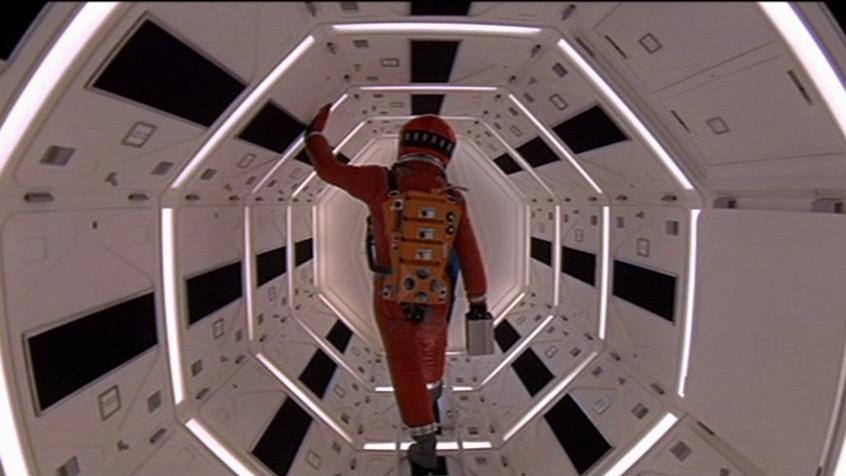
Our world is abuzz with concerns about the rise of artificial intelligence and its potential impacts on our jobs, social relationships, environment, and society. As artificial intelligence systems become more powerful, one of the core challenges is ensuring that they remain aligned with the moral values and desired outcomes of their human creators, which are often subjective, nuanced, and difficult to articulate.
This challenge is known amongst researchers as the A.I. alignment problem. Perhaps no figure better illustrates this challenge than HAL 9000, the fictional antagonist of Stanley Kubrick’s science fiction masterpiece 2001: A Space Odyssey (1968), whose unyielding execution of his pre-programmed mission has catastrophic consequences for the astronauts aboard the spacecraft.
In this Science on Screen event, Sarah Dean, Associate Professor of Computer Science, will discuss the historical development of artificial intelligence and machine learning systems since the 1950s. She will also consider how HAL 9000 helps us understand the limitations of and ethical challenges presented by autonomous decision-making in algorithmic data models, including the A.I. alignment problem.
Free admission! This screening will be presented as part of National Evening of Science on Screen®.
Science on Screen® is an initiative of the Coolidge Corner Theatre, with major support from the Alfred P. Sloan Foundation.
About the speaker
Sarah Dean is an Assistant Professor of Computer Science at Cornell University. She studies the interplay between optimization, machine learning, and dynamics in real-world systems. Her research focuses on understanding the fundamentals of data-driven methods for control and decision-making, inspired by applications ranging from robotics to recommendation systems. She completed her postdoctoral research at the University of Washington and earned her M.S. and Ph.D. in electrical engineering and computer science at the University of California, Berkeley. Dean received her B.S.E. in electrical engineering and mathematics from the University of Pennsylvania.