
Cría cuervos. . .
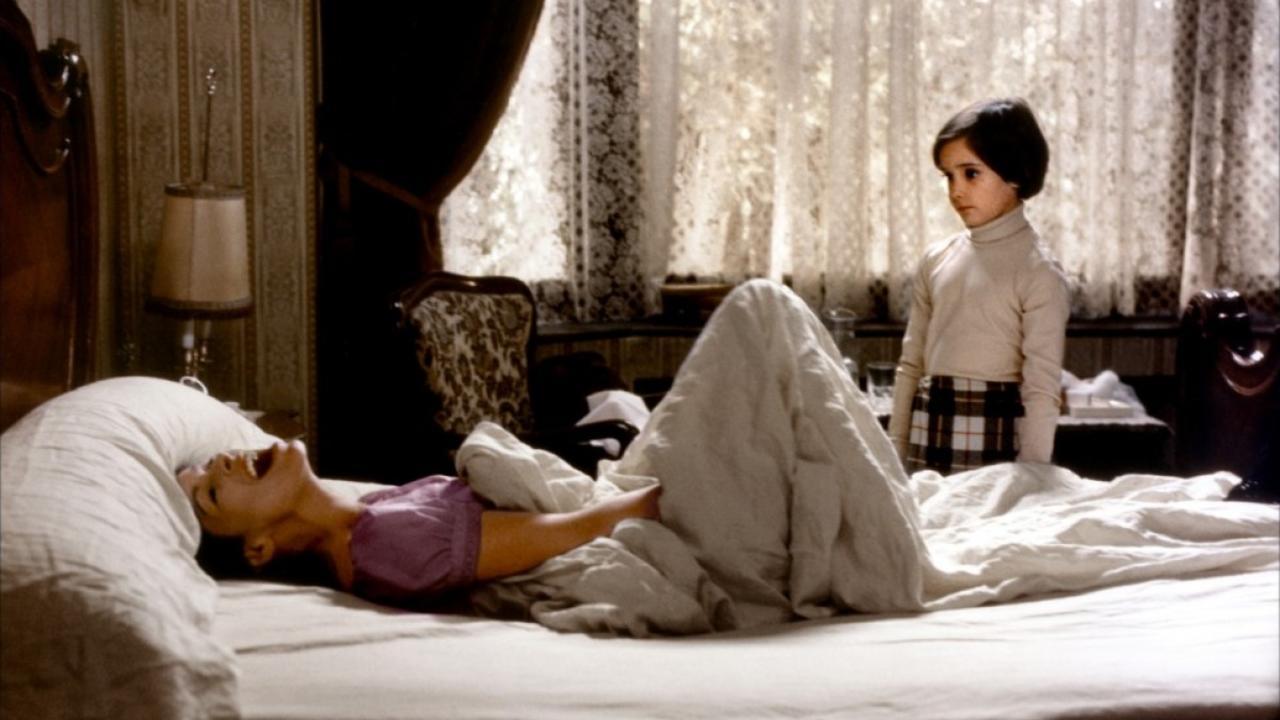
Set to the pop song “Porque te vas,” composed by José Luis Perales and performed by Jeanette, one of Cría cuervos…’ most remembered scenes shows three girls dancing together in an otherwise silent house, softly singing lyrics that include the lines “I will cry like a child… because you are gone.” The moment is joyful and unsettling at once: a childlike performance of grief that takes the form of play.
Released in 1976 and filmed on the eve of Francisco Franco’s death, Cría cuervos… is set in mid-1970s Madrid. The film centers on Ana (Ana Torrent, in a landmark performance at age eight), a young girl living with her two sisters in a large, enclosed family home, an urban mansion sealed off from the city and a metaphor for a country still under dictatorship. After the deaths of her parents, Ana inhabits a domestic world structured by memory, authority, and absence, and games become a way of rehearsing causality. Does she have the power to influence whether others live... or die?
Cría cuervos holds together two registers without resolving them: the intimate force of a child’s guilt and the broader atmosphere of historical transition. Carlos Saura rejects visions of childhood as a sheltered stage of life, presenting it instead as a site where fear, responsibility, and loss are felt with full intensity. Cría cuervos… thus asks us to attend to scale differently: not by opposing the child’s small world to national history, but by showing how historical forces are lived, rehearsed, and absorbed at the level of play.
The film will be introduced by Isabel Calderón Reyes, a PhD Candidate in Romance Studies at Cornell University and a Mellon Graduate Fellow with the Society for the Humanities.
Free admission! Sponsored by the Society for the Humanities as part of our "Scale on Screen" film series.
The film screens in a 35mm print courtesy of Janus Films. In Spanish with English subtitles.